Perspective on Change
in the Earth System
Change is a natural component of Earth’s geological, biological,
ecological, and processes. The
topography of the Earth has changed over many millions of years. Mountains have gradually risen to stand where
vast seas once flowed—and vice versa. Likewise,
the theory of evolution is all about biological change happening over very long
timescales. While it’s still a source of
debates between scientists and theologians, I personally believe evolution offers
the most credible explanation of how we’ve arrived at where we are today.
Similarly, throughout Earth’s history, climate has fluctuated and ecosystems
have changed in response. Glaciers have slowly
advanced and retreated, and so on. Given long enough, a lush forest can become a
desert.
For many millions of years, the components of the ecological system stayed in balance. Whatever resources creatures needed to take
for their survival, the Earth was able to replenish naturally. After humans
emerged, the rate of change accelerated.
In the creation narrative of Genesis, we learn that God created humankind in his image and gave us dominion over creation—Genesis 1:26-28. This poetic
description of the origin of humans seems consistent with what science has
shown us. While no one knows exactly how
it happened, it is clear that there was a jump in the intellectual—and
spiritual—capacity of humans, allowing us to develop capabilities setting us
apart from all other creatures. Among
the most noteworthy is that we seem to have a built-in sense of morality—regardless
of our specific faith or lack thereof. We
also have a unique sense of the world beyond ourselves and are capable of
entering into relationships with others, and with God. These traits are not intrinsically good or
evil—we have free will to choose what
to do with them.
The irony is the same
free will that is required for a
creature to reflect the image of its Creator can also be misused to destroy the
very creation that the Creator so loves.
Human beings have changed the planet more than all other
creatures combined. Some of that change
has been extremely good and beneficial, but some of it has been quite ugly and
destructive. From the very beginning,
God placed limits on human beings and we struggled to live within them—Genesis 2:15-17. Driven by our desire for progress and
prosperity—and ultimately our desire to be in control— we often chose to ignore
those limits with disastrous consequences—e.g., Genesis 3. We’ve interpreted
the words of Genesis 1:28 as
justification for being allowed to take whatever resources we desire, with
little or no regard for the impact on the creation itself—including other
creatures and even other human beings. In
so doing, we’ve pushed way beyond the system’s natural ability to replenish
itself. We’ve consumed resources like
water and oil exponentially faster than they can possibly be replenished, and
pumped out waste products, which threaten the water we drink and the air we breathe.
Evidence mounts that
the early 21st century is a critical point for Earth’s climate. At some point our conspicuous consumption was
bound to catch up to us, and we appear to be rapidly reaching that point. To put it simply, the planet just can’t take
anymore.
 |
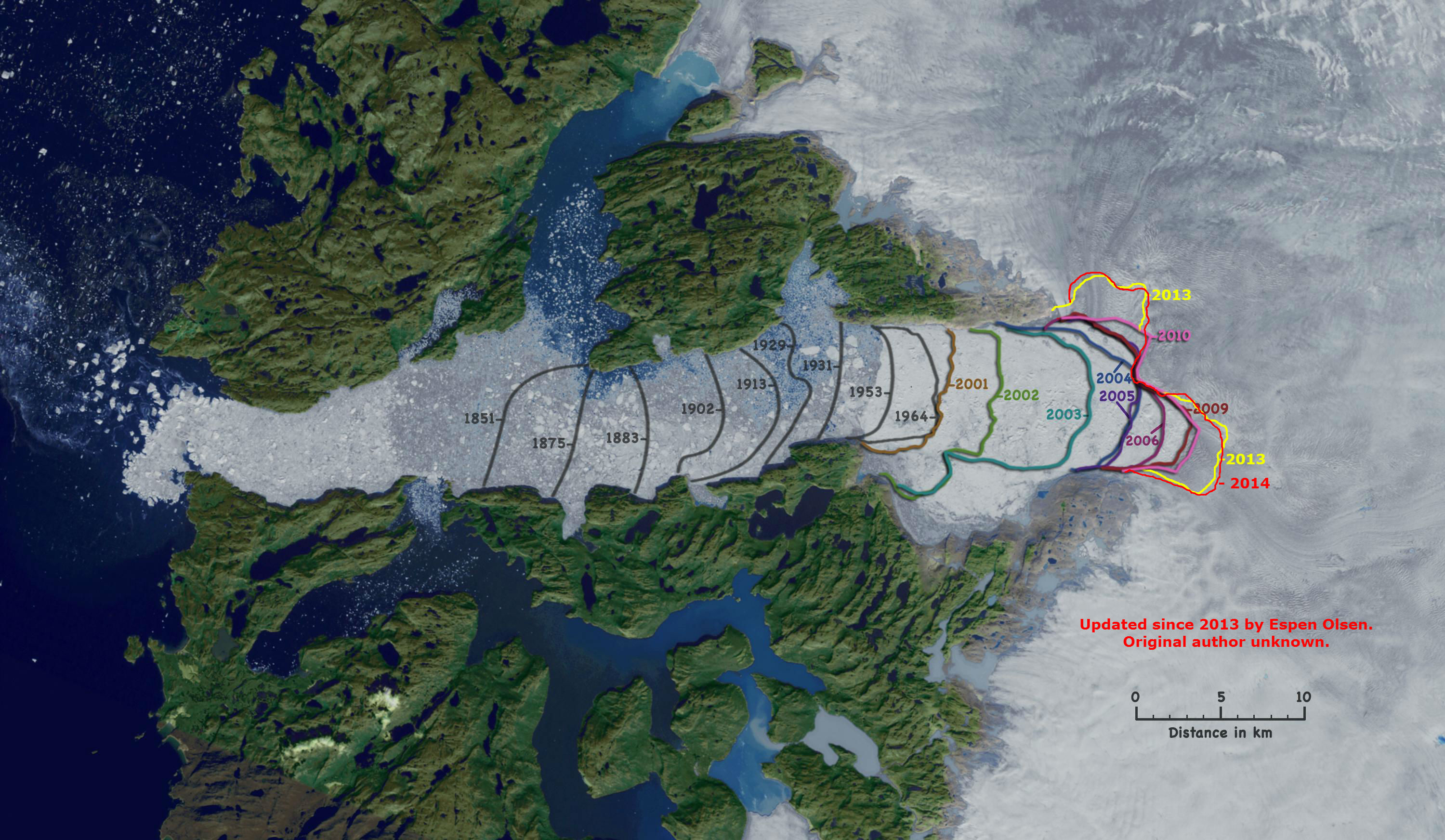
Nowhere is climate change more evident than in polar regions
like Greenland. Jacobshavn Glacier in
West Greenland is often cited as a dramatic example of the rate of climate
change accelerating in recent years. The
lines show the extent of the glacier in different years. Note how far inland the glacier has retreated
since 1850; in particular, notice the rapid retreat just since 2001. Image
credit: Originally from NASA
|
How Should We Respond
to Climate Change?
While most now accept that climate change is happening, many
still claim that it is not a serious issue, especially relative to other issues
we face as a society.
They point to past
“natural” changes and argue that the human contribution is small relative to
the forces of nature.
Some will even argue
that government agencies like NASA have a vested interest in making us believe
the worst about climate.
As someone who
has spent nearly half his life training in science and “working for NASA”, I
strongly disagree.
While not all data is
perfect, it is not wise to defame NASA’s credibility over one or two claims
that are later refuted because of bad data or new evidence.
This does not indicate an overall conspiracy
to “cook the books” to make things look bad.
The fact is that NASA and other nations have gathered decades of
satellite, aircraft, and ground-based data to support the claims made about the
reality of climate change. The
global view enabled by satellites over the past
~30-40 years has been particularly important in observing this change over time
.
Establishing a clear
human footprint
on climate change is harder, but scientists are making progress in sorting out
natural changes from those that can be attributed to human activity.
Scientists don’t make the claims they make
lightly.
Anything published has to be
“peer reviewed” meaning that the credibility of claims made has been
scrutinized before it becomes public.
Others may admit climate change is happening but argue we “can’t
be sure” human activity is to blame, so it would be irresponsible to risk our economic
prosperity to change policies (such as limiting the amount of carbon dioxide we
release into the atmosphere) when there is still “so much uncertainty”
surrounding the issue. While it’s true
there are still some uncertainties in the exact causes of climate change, the
overall conclusion they reach just doesn’t hold up to serious scientific scrutiny.
The Earth’s climate is changing at rates unprecedented in
Earth’s history.
The majority of
scientists now agree that the
change has a distinctive human footprint .
The question is no longer
if climate
change is happening, but rather what should be our response?
By the time we are
“absolutely certain” about whether the “smoking gun” of climate change points
toward humans, it will likely be too late to do anything about it.
Should Christians
Care About Climate Change
Some believe that
creation care need not be a priority for followers of Christ—since our ultimate
destination is heaven. I too believe we
are destined for heaven, but not yet—hopefully
not for a while; I think what we do now
in this life has just as much eternal significance as what we do in the life to
come.
I believe that Scripture witnesses to this truth from
beginning to end. Both the Genesis text
and scientific discovery concur that humans are unique from all other creatures
God created. We are the pinnacle of
Creation and are meant to have a special role in caring for it. The poetry of the Psalms and prose of the
Prophets proclaim God’s glory revealed through Creation. Several Prophets paint pictures of a day of the Lord, when God restores the
Earth to its original glory. We, God’s
followers, are the ones God uses to do that restoration. In the Gospels, we see
that Jesus was connected to Earth; he was after all the incarnation of God, and lived on Earth for 33 years. He spent most of his time in the countryside
of Palestine speaking to people familiar with working the Earth and evokes
images of plants and animals frequently in his teaching. (Paul by contrast spent
most of his time in urban areas.) Revelation ends with images of a new heaven literally descending to
Earth.
The Earth matters to God and caring for it is
a calling for God’s people.
Climate change is an issue that transcends any particular
religious identity. It has the potential to impact every person living on
planet Earth in some way; thus, we all have a stake in figuring out
what to do about it. We can no longer ignore it and/or expect others (e.g., environmentalists,
politicians, future generations) to resolve it.
Indeed, we are all on planet Earth together. What impacts one of us impacts us all; what
impacts the quality of life for our children’s children should concern us.
We’re On It—Together
Your planet is changing. We’re on it. —NASA, Earth Right Now
The NASA News Team came up with
the slogan above for a recent campaign. It conveyed what is now pretty much
accepted as fact: The planet is changing.
The second part said: We’re on it,
which I think is intended to have a double meaning. On one hand, it conveys the message that we (the NASA News Team) are on top of
the latest stories about climate change and will report them to the
public. On the other hand, it also
implies that we (all of us) are all
on planet Earth together, which most scientists agree, is changing at rates
unprecedented in its history.
Interdisciplinary
scientific study has led us to the point where we now understand climate change
to be one of the great societal concerns of our time but science alone won’t
lead us to a solution; I believe interdisciplinary faith dialogue will be
required to solve the problem.
Interestingly, one of the leaders in this dialogue has been
Pope Francis.
He has been a revolutionary
Pope in many ways since becoming leader of the Catholic Church in 2013, none
the least of which is his overt concern for the environment.
Francis released the first
Papal Encyclical entirely devoted to environmentalism, in which he encourages all people on the planet to
make care for the environment an important part of living out their faith
.
The Pope writes:
A very solid
scientific consensus indicates that we are presently witnessing a disturbing
warming of the climatic system. In recent decades this warming has been
accompanied by a constant rise in the sea level and, it would appear, by an
increase of extreme weather events, even if a scientifically determinable cause
cannot be assigned to each particular phenomenon. Humanity is called to
recognize the need for changes of lifestyle, production and consumption, in
order to combat this warming or at least the human causes which produce or
aggravate it —Pope Francis, Laudato Si’, 23.
Be Like the Bereans…
and the Wesleys
When Paul encountered the Berean Jews on his journey, he
described them as having “more noble character” than those he had met in
Thessalonica. Why did he conclude
this? Because, rather than rejecting
his message on face value, they were willing to go home and consider it. He says they examined the Scripture for themselves to see if what Paul was saying
was true—Acts 17:11.
When considering a controversial issue like climate change, there
are bound to be passionate defenses of "both sides". People of faith can honestly disagree over what the “correct” response
is but we human beings have this rather nasty tendency to “demonize” those with
whom we disagree. We must avoid that
temptation.
When these kinds of issues arise, as they inevitably will, we
need to be more like the Bereans. Our challenge is not to accept (or reject) the
words in this essay on face value—i.e., to form an opinion just because the
author “works for NASA”. Study the issue
and seek to discern the truth for yourself.
Our call is to be ready
to give account for what we believe
beyond simply quoting the “gospel” of our favorite news program or talk show
host. We should consider information from a variety of perspectives and develop
our own ability to discern what sources are credible and trustworthy.
Remember that reason
is a key component of the Wesleyan Quadrilateral, which is intended to help us
discern our way through issues—along with Scripture, tradition, and
experience. Scripture is considered
“first among equals” but you won’t find much about topics like greenhouse gas
induced global warming in Biblical writings, the most recent of which is just
under 2000 years old. So we have to
depend on other sources to draw our conclusions. And that’s okay! There is no call to “check our brain at the
door” for followers of Jesus—and particularly for followers of the Wesleyan
Way. Complex issues such as these require the union of knowledge and vital
piety that Wesley longed to see.
Responding to the Call
to Care for Creation
Pope Francis will visit the U.S. in a few weeks, including a
visit to Washington D.C. Among the other
activities on his busy agenda while in DC is an address to a joint session of
Congress. It is likely he will lift up
environmental concerns in his speech.
There is an
opportunity to add your voice to this important conversation on climate change coming
up at an event called, Coming Together inFaith Celebration ,
taking place Thursday September 24 at National Cathedral in Washington, DC.
This gathering will bring together faith communities for
inspirational messages, songs and poetry to inspire and connect faith and
climate leaders and build momentum for action.
Our planet is changing. We’re on it—together.
It almost seems like this slightly modified NASA
slogan could have been God’s slogan from Day One. From the very beginning, God has entrusted
human beings with care of creation; God calls us to continue the work of
creation. Today, our planet faces a critical moment and God once again depends
on us to live up to our calling. I pray that people of all nations, races, and
faiths can figure out a way to work together for the common good of the world,
and that by doing so, our society can figure out effective means to address climate
change—one of the pivotal issues of our time.
The stakes are too high for us to get this wrong. I don’t think it’s too much of a stretch to
say that the ecological future of Earth lies in the balance.