Tuesday, July 2, 2019

Taking Pride in Being Authentically Ourselves

My family recently participated in the Southern Maryland Pride event in Solomons, MD. As most know by now, the United Methodist Church’s General Conference recently voted to strengthen its stance against Lesbian, Gay, Bisexual, Transgender, Queer… (LGBTQ+) individuals.  In light of this decision, my wife (a UM pastor) wanted to attend Pride to stand in solidarity with the LGBTQ+ community in our area, and to let them know they are loved—and welcome at our church. I confess I went somewhat reluctantly.  This was my first time attending a Pride event. Even though I had been assured the event was much smaller and more “family friendly” than the Pride events in “big cities,” I wasn’t sure what to expect. I could’ve easily found something else to do that morning.  I’m glad we went together as a family, though.  It was good for my children to experience—but it was good for me too. Like Mr. Wesley going to Aldersgate, I went reluctantly, but by the end of the day my heart was “strangely warmed”.

I didn’t know the history behind these Pride events before I went.  I may have heard of Stonewall before I went to Solomons, but I certainly didn’t know the details.  This was when police raided the Stonewall Inn in Greenwich Village in Manhattan, setting off several days of violent protests involving LGBTQ+ people.   

The first Pride rally took place in New York on the first anniversary of Stonewall, on June 28, 1970. The original rally was purely a political protest but over time they have morphed into events that combine a rally and a celebration of LGBTO+ life—which is a good description of what I experienced at Southern Maryland Pride.  There are now rallies of varying sizes all around the country; most tend to take place in the month of June.  This year marked the fiftieth anniversary of Stonewall and this year’s Solomons Pride march’s theme was: From Stonewall to Solomons: We’re Still Here.

There were a number of speakers at the event, followed by a march up the boardwalk in Solomons. Probably the most impactful words I heard that day was from a young trans-gender individual, who is currently transitioning from she to he.  The individual was justifiably emotional as he described how s(he) wrestled with all the emotions surrounding his identity and the ramifications of the choice he made to transition.  He said he finally came to the point where, “he made a choice to live his life in a way that didn’t hurt anymore”.

That quote reminded me of a movie scene I come back to again and again.  It is the moment in the movie,The Return of the King, where Elrond comes to Aragorn (who up until now he has been living as Strider, or “the Ranger”) and presents him with the blade of his ancestors that Elrond has had reforged. He tells Aragorn to put aside “the Ranger” and become who he was born to be.  It’s time for him to stop hiding in the shadows and go public with who he really is.  Middle Earth needs Aragorn now—not Strider. No matter how many times I see the movie, this scene always undoes me.


I think this scene is transcendent because Elrond doesn’t just speak to Aragorn in that scene, he issues the same challenge to me—and to you, and to everyone, to drop the “masks” we wear once and for all and be authentically ourselves—without apology.

 “Let people feel the weight of who we are—and let them deal with it.”—John Eldredge  

This quote is both inspiring and sobering.  Who doesn't long to do just what it says?   And yet it also hints at the unfortunate reality that it’s often much easier to say it than to actually do it in this world.

Making the choice to be authentically ourselves is bound to make others uncomfortable.  And, we were reminded at the Pride rally, that when people get uncomfortable, they may choose to lash out at the source of their discomfort.  The parade route passed by Solomons UMC; the pastor of the church was one of the clergy that participated in the march.  The church opened its doors to the marchers on their return trip up the boardwalk, offering a place to rest for those who needed it, and refreshments for the marchers on their return trip.  It was a simple act of hospitality on a hot day. It was “what Jesus would do.”  

But at least one woman didn’t seem to agree.   As she drove by the church in her car, she made a point of rolling down her window to say such nice things as: Shame on you.  Go to hell.  Did I mention she fired off all this profanity with children present—including my own?  

**********************************
Unfortunately, too often we use our religion to justify our bad behavior, like the anonymous woman at the Pride rally did.  We quote Scripture to justify our decision to ostracize those different from us that make us uncomfortable.  When it comes to homosexuality, we like to say that we, “love the sinner but we hate the sin”.  Now, I admit, I used to think this way on this issue.  

But the more I’ve thought about it, I wonder if it’s actually possible to separate ‘the sin’ from ‘the sinner’?  

Maybe it can be done, but it seems difficult.  It seems like our vices often come right alongside our virtues, and the two are very difficult to separate, no matter how much we pray about it or how hard we try.  Our sin nature is part of what makes us human; it is the darker side (or shadow) of the good creation God has made in each of us—and God loves the whole package. 

“Human consciousness does not emerge at any depth accept through struggling with our shadow. It’s in facing our own contradictions that we grow.  It is in the struggle with our shadow-self, with failure, or with wounding that we break into higher levels of consciousness. People who learn to expose, name, and still thrive inside contradictions are what I would call prophets”—Richard Rohr.

So, it’s not that we don’t try to acknowledge and wrestle with our shadow-self, but it’s not something we ever completely eliminate.  In fact, there’s a sense that we need our sin nature, because the ongoing struggle with it serves as an impetus for continued growth, transformation, and movement toward God.  It certainly isn’t a precondition for God’s love for us to be rid of it.  That kind of makes logical sense to me.  I mean if we needed to be sin-free for God to love us, other than Jesus, who would qualify—Romans 3:23

**********************************
Some believe homosexuality is something that a person could choose not to be.  There was a time I might have agreed.  However, some books I’ve read the past few years have changed my thinking.  More importantly, I’ve had long-term friendships with several committed Christians who are gay. I remember one watershed moment in the evolution of my thinking on this issue was when my wife and I were sitting at the breakfast table (I think it was at Gary’s Grill in Severna Park, MD) with my wife’s long-time friend Beth (who has now transitioned to Grey). We were talking about Beth’s lifestyle and the challenges she faced being out as transgender.  At one point, she said simply: “Would I choose this?”   

It’s fair to say her words have stuck with me.  No… I don’t believe she would.  Nor would anyone choose to open themselves up to ridicule and shame by the “dominant” majority, including many Christians—including me—unless they truly believed they can do no other—unless they truly believed this was the only way they could be who they were born to be.

The fact that I don’t understand their decision or lifestyle doesn’t make it wrong.  The fact that these people being who they are sometimes makes me uncomfortable, as it did at the Pride rally, is my problem—not theirs. 

I have come to the point where I honestly think sexual orientation might be as fundamental to a person as sex or skin color or handedness. We tend to think of these characteristics as being binary.  That is, you are either male or female.  But I’ve come to understand that it may not be that simple.  As much as it stretches the mind of a Meyers–Brigg “J” like me, gender seems to exist on a spectrum—which when you think about it, is not unlike race, which is a mixed bag for many of us.  So, there is a sense that Sigmund Freud was right when he said, “we are all bisexual”.  What I take this to mean in this context is that we each have a particular mixture of masculine and feminine traits, and in rare cases it seems the outside appearance may not match interior makeup, manifesting as a trans-gender person.  

**********************************
Having been born a white male, I’ve never experienced harsh treatment simply because of my racial, gender, or sexual identity. The closest I can relate to the LGBTQ+ experience probably pales in comparison, but it does have a few parallels to their experience.  I was born left handed in a world where 90% of folks are right-handed.  There was a time when those born left handed were considered “wrong” or “backwards,” not unlike how some respond to LGBTQ+ people today.  Parents of children born left-handed used to try to “convert them” to right-handedness. (My wife’s mom is an example of someone who was “converted”.) Some say that homosexual individuals can be similarly “converted” to heterosexual orientation. I’ve read some “success stories” of people who claim they’ve been “converted”.   

While I don’t recall overt efforts to “convert” me to right-handedness, I do remember the experience of being left handed in school.  We sat at old, beat up left-handed desks, and cut with scissors that had big green handles and always seemed to be duller than the “normal” scissors. Honestly, I think at some point I just learned to use the right-handed scissors with my left hand—although, to this day, I look weird doing it and never can cut as neatly as others.  

Remember the scene in the Peanut’s Halloween Special when they are all dressed up in their costumes? Charlie Brown’s simple ghost costume has like twenty eye holes in it.  He says simply, “I had a little trouble with the scissors,” and the other kids laugh at him.   Having messed up my share of arts and crafts projects over the years while everybody else’s looks so much nicer, I can sympathize with how Charlie Brown felt in that moment.  I’ve walked some miles in his costume as it were.   I wonder if Charlie Brown was left handed too? 

Likewise, I learned to eat right handed, but always looked weird doing it.  My dad would always criticize me for “shoveling my food” when I ate.  He never figured out why it looked to him like I was “shoveling”. It was only once I got married that my wife noticed I was eating right handed and encouraged me to learn to eat the way that came more naturally to me. 

Later in life, I did ballroom dancing for over a decade, and it’s designed with the “dominant hand” in mind. I liked doing it, but I found it challenging to learn.  Most of the steps start with the leader’s right foot free, and support with the left side of the body—the opposite of how I’m built.  I’m sure there are fine dancers who are left-handed, but I always thought being left handed made learning to dance harder.  Let’s just say the “natural (right) turn” didn’t come naturally to me. Everything seemed backwards!  

Similarly, at any baseball practice, the few southpaws always stand out like a sore thumb from the rest of the kids.  Every drill has to be adjusted for the lefties. Just as with dancing, I know that being left handed doesn’t prevent success. In fact, some of the best pitchers in the Major League were/are left handed (e.g., Randy Johnson/Max Scherzer). In part it’s because there aren’t that many of them out there, but I can’t help but wonder if it’s also because they had to work so much harder than the right-handed players to learn everything “backwards”.  

In short, we left-handers have to be taught to do almost every manual task just a little bit differently from 90% of the world!  My friend’s father once had a T-shirt that read, “Hire the left-handed.  It’s fun to watch them write.”  It’s true!  Think about it…  

All that to say that if homosexual preference is as fundamental as handedness, then I know from my experience that life will be already be harder for LGBTQ+ individuals precisely because they are a significant minority in the world.  So, who am I to heap on additional layers of shame by telling them that who they are is “incompatible with Christian teaching”, and that God doesn’t accept them the way they were created?   

If God can love a “backwards” southpaw like me, then surely loving an LGBTQ+ individual isn’t much of a stretch. 

**********************************
As I said earlier, I went to the Southern Maryland Pride rally reluctantly—but it was an impactful experience for me.  The young person who spoke at the event has no doubt encountered hatred and resistance throughout his life from people who are not comfortable with who he is.  The fact that, in spite of all that vitriol, he still had the courage to stand up and proclaim his choice in public speaks volumes to me about his character and authenticity.  He displayed more courage than I would have in that situation.  I would worry about what others would think if I were that brutally honest about who I am.  He knows full well the flack he will take from some for his choice to “go public” and nevertheless he persists in becoming who he believes he was created to be—and chooses to “let the world deal with it.”  I may not understand it; I might not even completely agree with it; but I have to respect it.
“Don’t ask what the world needs. Ask what makes you come alive and go do it. Because what the world needs is people who have come alive”Howard Thurman.
I love this quote from Thurman; I want to live this quote. But I find it so much easier to write about it than to do it.  Maybe that’s why what the young speaker at the Pride rally said resonated with me so much. He not only figured out who he was—but then he had the courage to go public with his identity.  He’s choosing to live in a way that makes him feel “fully alive.”  In this sense, I want to be like this young man!   I pray every day for God to help me, “live my life in a way that doesn’t hurt anymore.”  In other words, I seek to find ways to be more authentically and unapologetically me.  I ask for the courage to let the world feel the full weight of who I am and let them deal with it—and I trust God to deal gracefully with my reluctance and unbelief.  

"The glory of God is man (or woman) fully alive"
St. Irenaeus. 

What I think this quote means is that God is made more visible in our world as more of us “become who we were born to be.” 

I hope you will join me in seeking to be more authentically and unapologetically yourself.  I think this is what Jesus calls his followers to become as we follow him.  It is a certainly a countercultural act in a world that places us under such pressure to conform to the expectations of others and to base our identity so strongly on our group affiliations.  I think Howard Thurman was trying to tell us not to spend our lives trying to simply be what “the world” (you could substitute any group to which we belong for world: e.g., nation, community, work peers, family—and, yes, even our church) tells you that you are expected to be.  To say it another way, we shouldn’t feel that we have to censor ourselves in order for “the world” to accept us. No, says Thurman, “Ask what makes you come alive and go do it (be it),” because, whether we realize it or not, what “the world” desperately needs right now is more fully alive people.  

Friday, May 24, 2019

Seeing Christ in All Things

I’ve started reading a book by Father Richard Rohr called The Universal Christ: How a Forgotten Reality Can Change Everything We See, Hope For, and Believe.  What he’s talking about can boil down to the following statement: 

Christ is not Jesus’s last name. 
Christ is who Jesus was from the beginning.  

Now, we may think we already know that.  After all various scriptures speak of Jesus existing from “the Beginning”—John 1:1-18Colossians 1:15-20Ephesians 1:13-14—but Rohr challenges us to think about the implications of this.  Do we really live like Jesus is Christ (Messiah, liberating King of the Universe, savior of the world) or do we reduce him to the role of Personal Savior, who assures me that I am going to heaven when I die, likes the small group of people I like and promotes their success, and pretty much condemns the rest to hell?   

 “Christianity has become clannish to put it mildly,” says Rohr. “But it need not remain there.   The full Christian leap of faith is trusting that Jesus together with Christ gave us one human but fully accurate window into the Eternal Now that we call God (John 8:58Colossians 1:15Hebrews 1:3, 2 Peter 3:8). This is a leap of faith that many believe they have made when they say, “Jesus is God!”  But strictly speaking, those words are not theologically correct:
·     Christ is God, and Jesus is the Christ’s historical manifestation in time.[1]
·     Jesus is a Third Someone, not just God and not just man—but God and human together.
Rohr continues, “A merely personal God becomes tribal and sentimental, and a merely universal God never leaves the realm of abstract theory and philosophical principles. But when we learn to put them together, Jesus and Christ give us a God who is both personal and universal”—The Universal Christ, Chapter 1, p. 19.

I think, for most of us reading this article, we’ve grown up in churches that focus much more the personal dimension of Jesus, so that’s where we’re comfortable.  Talk of a universal Christ raises red flags for some.  It can begin to sound like pantheism, which means, “God iall things.”  So, the bird, or the rock, or the tree literally is God.   That’s not what Rohr is describing, however.  He is talking about panentheism; which is a similar word, differing by only a tiny syllable; but that little “en” makes a big difference.  

Panentheism means that “God is all things”, which means that God is not the rock, or the bird, or the tree—but God (Christ) is in all these things, and in everything else that God has created.  So, Christ can be seen in all of creation—and the ultimate revelation of Christ is Jesus. This idea is the bedrock of the theology the Apostle Paul advocates so strongly in his writing.  Rohr points out that Paul uses the phrase en Cristo, or “in Christ,” 164 times—which is more than any other phrase he uses in his letters.  
in 

According to Rohr, “En Cristo seems to be Paul’s code word for the gracious, participatory experience of salvation, the path that he so urgently wanted to share with the world. In Paul’s mind, we’re all living en Cristo; it’s only by our own negative choice that we remove ourselves from God”—The Universal Christ, Chapter 3, p. 43.  

That last sentence from the quote above sounds similar to C.S. Lewis, who wrote in The Problem of Pain that, “The gates of hell are locked from the inside.”

What might it look like to see Christ in all things?  I think I experienced this recently, when my family attended the wedding of my niece (by marriage) Nancy Leigh Gates to Louis Martinelli.  We had a beautiful weekend celebrating the joining of these two lives as one. We didn’t go to church last Sunday as we normally would.  Nevertheless, I feel as though the weekend was thoroughly God-soaked It was hard not to see God in what was taking place.

To begin with, I saw God in the circle of life playing out.  My wife was a junior bridesmaid in the marriage of Nancy Leigh’s parents, her brother John and his wife Kathy, nearly 43 years earlier, and Nancy Leigh was a junior bridesmaid in our wedding nearly 16 years ago.   So, it was a real joy for our family to not only attend, but to be participants.  Brady and Becca were both in the wedding party; Laurie was the officiant; and they even asked me to read Scripture.  It was truly a family affair. 


I also saw God in bedrest, ginger-root tea, and antibiotics.  Our family battled sickness (allergies/virus) during the week leading up to the wedding and it was touch-and-go for a while whether Laurie and I would have adequate voice to do our speaking parts.  But God was faithful; when Saturday came, both of us were able to do what we needed to do.

As one might expect, I saw God in the wedding ceremony.  This young couple clearly made an intentional effort to invite God to join them at the altar.   During the ceremony, I read four Scriptures that spoke of love, including the story of Ruth and Naomi.  Laurie's homily focused on the love that Ruth showed for her mother-in-law, and the love she found from an unknown God as she journeyed far from her homeland to fulfill her promise, and how Ruth ultimately became the great-grandmother of Israel’s greatest King (David). God is found in God’s Word.  As Ruth gleaned from the fields long ago, so the ancient stories of Scripture have wisdom for us to glean today. 

 But beyond the places you might expect to find God at a wedding, Christ played in other places over the weekend.  I saw God in the expressions on the faces of the bride and groom, the bridesmaids and groomsmen, and family and friends at the wedding rehearsal, the rehearsal dinner, the ceremony, and the reception.  The reception was a joyous celebration for Nancy Leigh and Louis—a very tasteful affair. We know Nancy Leigh waited a long time for this day to come, we were glad we could be there to celebrate with them.  

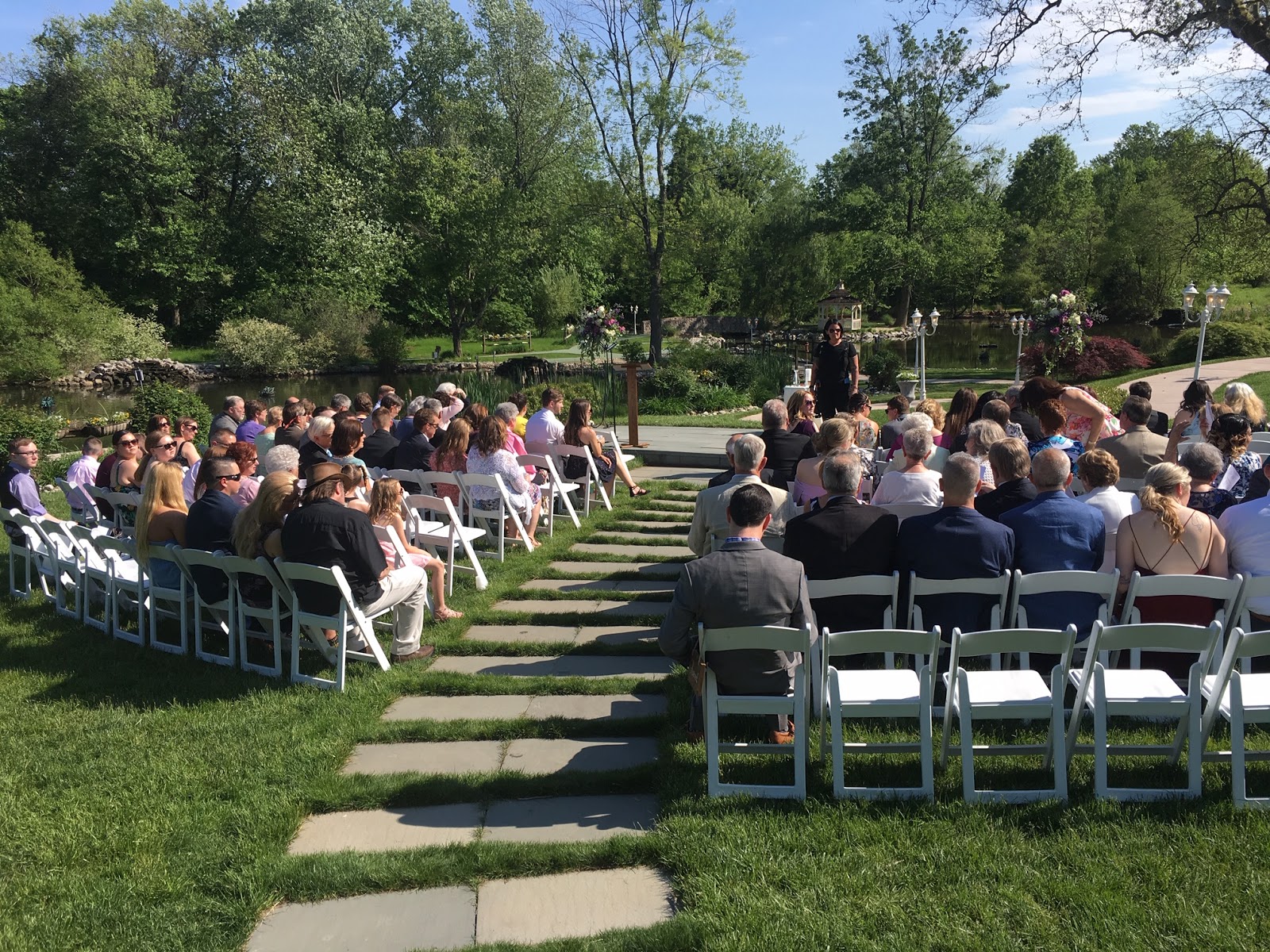
I also saw God in the casually elegant venue that was the perfect place for a young couple to have a wedding.   It was a great setting for both the ceremony and reception.  God was also there in the natural beauty nestled right in the suburbs of Philadelphia—not far from the “Blue Route”.  There was a stream with fountains, which activated when the couple kissed—a tradition they borrowed from Disney I believe. Beautiful flowers adorned the grounds, and a couple of huge trees grew on the property, and from one of those massive limbs hung a rope swing.   I found myself wondering how old those trees were—and the stories they could tell if they could speak.  

Indeed, God was there in the faces we encountered, and the spaces and places we visited last weekend. We just needed eyes that saw... 


I’m sure that I was a bit predisposed to see Christ in all things this weekend.  I was after all reading a book about seeing Christ in all things, and a Christian wedding is the probably the kind of event that naturally predisposes one to “seeing God” more readily than some other events.   Nevertheless, I really do believe that in this world, as the late Eugene Petersen put it in one of his book titles, “Christ Plays in 10,000 Places”.  The question is, are our senses tuned to see, hear, smell, touch, and taste the Christ in the faces we encounter, and in the spaces and places we find ourselves?  Or are we so conditioned to only look for God in certain places (e.g., in church on Sunday morning) that we miss so much of what God intends for us to see?  

Church as we know it seems to be dying. Young people don’t seem all that interested in the version of Christ we’ve been presenting.  The statistics speak for themselves.   No need to rehash them here.  Congregations are greying; pews are emptying.  Sunday Schools are sparsely attended.  

For many people it seems Christ plays anywhere but “in church” on Sunday morning.

According to Rohr, “Right now, perhaps more than ever, we need a God as big as the still-expanding universe, or educated people will continue to think of God as a mere add-on to a world that’s already awesome, beautiful, and worthy of praise in itself. If Jesus is not also presented as Christ, I predict more and more people will not so much actively rebel against Christianity as just gradually lose interest—Universal Christ, Chapter 1, p. 17.

So, if Rohr is right, maybe we need to give this Universal Christ some serious thought.  While I don’t necessarily embrace Rohr’s theology completely, I do agree with him that we need to present Jesus Christ as both personal and universal savior.  Focusing as much as we have on personal salvation, in my humble opinion, has not done the Church any favors.  

I don’t think “going to heaven when we die” is enough to make young people embrace Jesus.  They need a larger vision of salvation that impacts their life and gives them hope now—as well as a promise forlater.  They need both Jesus and Christ.

The future of “the Church”, which I’ve been part of my whole life, is unclear, and I find that unsettling. What kind of church will be left when my kids are adults?  How about when their children are born?  I honestly don’t know.  While I’m convinced “the Church” will endure in some form, I  honestly don’t know what it will look like.  To recognize it when we, or our children, see it will likely require us to learn to see Christ playing in places where we didn’t expect to find him.  Confining God to the crumbling conventional church structure simply isn’t going to cut it anymore.  (Not that Christ isn’t there… but that he is found in so many other places as well.) The urgency to learn to see “Christ in all” has never been greater.  I hope our eyes can adjust before it’s too late…  The lyric from the song, Glory is Here, contains our prayer request: Lord, “help me to see that you’re all around me".  Even better, I hope the next generation of Christ-followers can learn to see Christ where we couldn’t (or wouldn’t)—and perhaps teach us to see what they see. 


[1]This description makes me think of Jesus as the humanavatarof the Christ (in whom the fullness of God was pleased to dwellColossians 1:19) making God more accessible/understandable to us as human beings. 

Saturday, May 11, 2019

Stories of Messy Motherhood

Anna Jarvis—originator of Mother's Day
This Sunday is Mother’s Day.  The modern incarnation of the holiday dates back to 1908 (second Sunday in May formally became Mother’s Day in 1914.)  Anna Jarvis is the one credited with establishing Mother’s Day in the U.S.  She wanted a to honor her own mother’s memory by continuing the work she started but she also wanted to set aside a day to honor all mothers because she believed a mother was “the person who has done more for you than anyone else in the world.”

It didn’t take long for the secular world to catch on that this honoring of mother could be a good way to make a brisk profit.  After all, everyone has a mom.  As early as the 1920s, Hallmark was already producing cards the day.  Much to Anna Jarvis’s chagrin, Mother’s Day became a Hallmark Holiday.  Somewhere amidst all the frenzied gift-giving, the original noble intent of the Holiday got lost.  Ironically, Jarvis found herself protesting against the commercialization of the very holiday she had worked so hard to start.  She tried in vain to keep the focus more on the sentiments and less on the profits.  (Could we not say similar things about what Christmas and Easter have become in our culture?  Have they become Hallmark Holidays as well—at least for some, if not the majority?)

In church on Mother’s Day we typically read some form of liturgy or say a prayer that acknowledges the broad definitions of motherhood.   We affirm in words the messy reality of life: that while “the person who has done more for you than anyone else in the world” is often our biological mother, it isn’t always the case. 

But even when it is biology that bonds us, the emotions of Mother’s Day are more complicated than the saccharine sweet sentiments, and pithy platitudes of a Hallmark card.  Consider, for example, a sampling of the complex array of feelings about Mother’s Day that intersect with single human life—my own.  Tales of messy motherhood abound.  

Mother’s Day is always bittersweet for my family; in fact, early May is pretty much a time when celebration and sorrow come uncomfortably close together for us. To be honest, I feel challenged to know exactly how to respond to Mother’s Day.  On the one hand, it is a day I want to celebrate my wife, Laurie, for the wonderful mother she is to Brady and Rebecca, our son and daughter,  and my wife and I want to give thanks for our moms, and for others in our lives that have been “like a mom” to us.  

But Mother’s Day also has an inescapable shadow-side for my family. To begin with, my mother has been mentally ill for most of my life, which means that your typical Hallmark sentiment often doesn’t feel applicable to me.  Don’t get me wrong, my mom has given her all for me and my brother, and I’m grateful for that; it’s just that many pre-made cards just don’t quite fit our relationship.  Maybe that’s why I often choose to write my own words—much like Anna Jarvis advocated when she was alive.  

The awkwardness surrounding Mother’s Day goes beyond my relationship with my mom however.  The second Sunday in May always falls close to a somber anniversary for my wife and me.  It was on May 10, 2008, that we had the funeral for Rebecca’s identical twin sister Hope Marie, who passed from life support to life eternal two days after her birth.  Not only that, but Mother’s Day reminds us of another loss.  It was on Mother’s Day in 2007 we found we were expecting; but that pregnancy ended about a month later with miscarriage.  But then life rallied;  out of that loss came Rebecca—and Hope. 


What can one do with all those mixed emotions around Mother’s Day except let it be what it is, and ask for God’s grace to help you navigate it each year?

And this year, there’s another layer that hits pretty close to home for us.  On May 4, the anniversary of our daughter Hope’s passing, Rachel Held Evans, a 37-year old author and theologian whom we both admired and respected for her prophetic witness passed away, leaving behind two children under the age of four. Those two children will have little if any memory of their mother—but her husband Dan will never forget.  Mother’s Day will forever be bittersweet for that family.  And we simply don’t understand why these kinds of things keep happening to “good” people on this planet?? Lord have mercy…

Life often reminds us that mothers aren’t always connected to us by blood—and in the end a mother’s love can triumph over tears.  My wife’s father had five children by his first wife, Nancy, who ironically also died at age 37 of a brain tumor, leaving Laurie’s dad on his own to raise the five boys.  But Ordway was fortunate enough to find love again, and his new wife (Laurie’s mom Dawn) became like a mom to those five boys, plus their three additional children, the youngest of which was my wife. I know it’s way too early to think about, but I find myself hoping that Dan Held can find love again as Ordway did—and find someone willing to be a mom to those two precious children. 

Can a man be like a mom?  Okay, I admit that’s an odd question, but I ask because I think I’ve seen it.  I had a good friend named Joseph Bell, who passed away suddenly about two years ago in September.  Joseph and I were in men’s group together called Godfellas for many years.  He left behind two daughters who were his heart and soul.  Although their mother is still alive, she was never mentally well the whole time I knew Joseph.  He and Diane eventually separated and Joseph had been a single dad for several years.  While the girls still visited their mother occasionally and had some level of relationship, it’s fair to say that for a good chunk of their life, Joseph was both mom and dad to those girls. He didn’t really have a choice. 

Joseph’s daughters have been fortunate to be adopted by another of the Godfellas, and his family.  Steve and Trish Audi already had two children of their own, but Joseph had asked them that question we often ask our trusted friends when we have small children and ask them:  In the unlikely event something ever happens to me, would you take responsibility for my children. Well, Steve and Trish thought about it, and most likely prayed about it, and said, “Yes”.  My guess is that they didn’t think much about it after that.  More pressing matters of life presented themselves and thoughts of the “unthinkable” receded to the background.  

For most of us, that’s as far as that conversation ever goes; it’s a hypothetical promise we will never have to fulfill.  The kids reach legal age, the parents remain perfectly healthy, and the God-parent role, whether we’re formally called that or not, is mostly symbolic.  Perhaps you show up for birthdays, confirmations (or first communions), and other key events in the children’s life, but participation is optional.  Let’s face it, being a God-parent usually doesn’t cost most of us that much.

But then there’s what happened to my friends Steve and Trish. In their case, the rubber hit the road one day in September 2017, and the hypothetical God-parent role suddenly became all too real.   In the days that followed Joseph’s untimely death. the Audis had to decide if they would fulfill that promise they made to Joseph.  It hasn’t been easy for them, but they’ve made an intentional choice to fulfill their promise over the past couple years, and with God’s help (as I am sure they would be quick to tell you) they continue to do it.  One of the girls was legally an adult already when Joseph passed away, but we all know young adults still need parenting in this world; the other was just 12 when Joseph died, so they essentially inherited an extra teenager in their home that already had two teenagers.  Almost overnight, their suburban family of four became a family of six—living in the same house that more comfortably fits four than six.  I never cease to be impressed by how the Audi family willingly took in two more children to honor a promise they made to a friend.  Trish truly became a mom to Felicity and Mellissa, Steve a dad, and their children Meghan and Michael, sister and brother.  

Watching the Audi family welcome the Bell children into their family after their father died has been a true witness to me of the reality that the cords of God’s love (agape) are even stronger than the bonds of human biology.

Consider that Mary was technically not Jesus’s biological mom.  If you remember the story, the child was from the Holy Spirit, and Mary served as a surrogate—a theotokos, or God-bearer. But, of course, history remembers her as the Mother of God, because—in all the ways that matter—that’s who she was!

Whether she intended it or not, I think Anna Jarvis nailed the definition over a century ago when she said that a mother was, “the person who has done more for you than anyone else in the world”.  These examples I’ve shared from my own life, and a matriarchal archetype from Scripture, bear witness to that broad definition.  They illustrate that this description can apply to many people in our lives—not just to the woman who gave us birth.

The truth is, it’s hard to put a boundary on what makes someone a mother—so I for one won’t try to be the gate-keeper. No matter how many lines you add to the litany, you still won’t capture all the categories, because, in the end, motherhood defies words.  I’m quite sure that each one of you reading this article can think of your own stories of messy motherhood to add to what I’ve shared.   Who would you point to in your own life as fulfilling the role of mother? As we celebrate motherhood this week, let us give thanks for all the mothers in our lives, and for God’s Mothering love for the whole world.  Have a Happy Mother’s Day!

Thursday, April 18, 2019

Viewing Easter Through Holy Week's Missing Window

Last November, as part of our church’s fiftieth anniversary, we had a sermon series that took us on a tour of the faceted art glass windows that adorn the sanctuary with images of the communion of saints hovering above us each time we gather for worship. Sometimes I can get focused on the details of the worship service, and forget the windows are there, but then I look up at just the right moment as sun shines through, and, at least for a moment, I am undone—captivated by the unfolding Biblical graphic novel above me.  The presence of the slender ribbon of windows lends an almost Orthodox aspect to our otherwise modern, suburban United Methodist (UM) worship space at Good Shepherd UMC in Waldorf, MD. 

From the guidebook to the windows originally produced for their service of dedication in June 1982, I learned that the windows are the handiwork of the Willet Stained Glass Studios of Philadelphia, PA.  The story they tell begins at the rear of the epistle side of the hexagonally shaped sanctuary—that's the left side as you face the altar. The summary of the Biblical story—and of our church’s story inside that larger Biblical story—unfolds as we make our way around the sanctuary.  (The original design of the sanctuary envisioned having church in the round, meaning that the altar space and seating could be shifted throughout the year, so that the congregation’s focus could shift to different windows during different liturgical seasons, e.g., there are windows focusing on the events of Advent, Christmas, Holy Week, and Pentecost.  However, conversations I have had with longtime members indicate that idea was quickly deemed impractical and was never actually done.)

Good Shepherd’s windows begin with scenes of familiar Old Testament stories, starting with Creation and moving through the stories of the Matriarchs and Patriarchs and of the Kings and Prophets.  About one-third of the way around the sanctuary, we reach the New Testament, with a good portion of the panels dedicated to scenes from the Life of Jesus as one might expect, followed by several scenes from Early Church history (most of which are recorded in Acts and the letters of Paul).  

After that, the windows conclude with a section that focuses in on the specific history of our local congregation.  We begin with the Protestant Reformation (showing Martin Luther), then move to the Methodist movement (showing Susanna and John Wesley, Francis Asbury, among others), and then there are several windows specific to Good Shepherd UMC, which began in 1968—the same year the UM denomination was created from a merger of the Evangelical United Brethren (EUB) and Methodist churches.  Several windows near the back of the church capture scenes of community life at Good Shepherd at in the late 1970s. They tell the story of our early years to all future generations that enter our sanctuary to worship. The final panel returns us to the larger Story of which our church is a part, with a representation of the consummation of all things predicted in Revelation.  

Our windows come out of a long-standing tradition of presenting Biblical stories using images and icons to not only beautify but also instruct.  In ancient and medieval times, when most worshippers were illiterate, such illustrations were essential to allow the worshippers to follow along with what the priest (who was literate) was reading from the Bible, which would’ve been in Latin.  Today we live in a world where literal illiteracy is less common—but where it seems Biblical illiteracy is becoming increasingly normative.  So, perhaps windows like these can serve an important outreach and teaching role in the church of 2019, just as they did a millennium ago. 

This week is Holy Week, and so our attention is drawn to the depictions from the last week of Jesus’s earthly life, which begin at near the front of the church on the right side of the altar—see photo below.  If you look at them you will see the events of Holy Week depicted:  the entry into Jerusalem, Jesus’s encounter with Zacchaeus, the cleansing of the Temple, the last supper, the foot washing in the upper room, the prayer in the garden of Gethsemane, the crucifixion (two windows), the women at the empty tomb, Jesus’s appearing to Mary Magdalene, the walk to Emmaus.  It’s all there—well, except onething.  Did you notice what’snot shown?  It’s actually a pretty big omission.  I’ll give you a minute…  

These are the colored glass windows at GSUMC.
that depict the events of Holy Week.
Note the bottom two windows in the vertical
column showing the Crucifixion. 
Look closely... The actual resurrection of Jesus is not shown.  It’s so obvious and yet we don’t notice.  Paul says our whole faith rests upon it—and yet it doesn’t rate a picture on our windows?  Why?  

It might be because Scripture is pretty quiet about what exactly happened on Holy Saturday.  In the words of John Dominic Crossan, “The major events from the Annunciation to the Ascension—are described in Gospel stories and so can be depicted in any medium.”  But then he adds, “but there is one exception in that overall sequence, one event in the life of Christ that is never described in any Gospel story. Furthermore, this is not some minor happening, but the most important and climactic one of them all.  This is the moment of Christ’s Resurrection—as it is actually happening. This—unlike all other Gospel events—is never described in itself.  But if it is never described in the text, how can it ever be depicted in an image?”

Well, thank God for Christian imagination!  Of course, there are plenty of images of the Resurrection.  Maybe precisely because it’s not described explicitly, artists felt the need to speculate.   Take a look at last two images in the bottom row of the sixteenth century Italian fresco shown below; these scenes are both commonly associated with the Resurrection.  

This is a picture of a sixteenth century Italian Life of Jesuscycle in fresco with 21 scenes from Annunciation to Resurrection: Top row: Annunciation, Nativity, Visit of the Three Magi, Flight to Egypt, Baptism of Christ, Raising of Lazarus, Entry to Jerusalem, Last Supper. Middle row: Washing of feet, Agony in the Garden, Arrest of Christ, Trial before the Sanhedrin, Trial before Pilate, Flagellation. Bottom row: Ecce homo, Carrying the cross, Christ falls, Crucifixion, Deposition from the cross, Harrowing of Hell, Resurrection.  Credit: Gaudenzio Ferrari, Stories of life and passion of Christ, fresco, 1513, Church of Santa Maria delle Grazie, Varallo Sesia (VC), Italy. 
I’ve been reading through Crossan’s book called Resurrecting Easter that traces the development of imagery depicting the resurrection.  I got it last year after Easter and decided that Holy Week 2019 would be a good time to read it. Crossan makes the point that unlike any other event in the Gospels, there are two distinctly different (and competing) types of images (or traditions) that have emerged over the centuries to speculate what the moment of resurrection looked like.  You can see them both illustrated in the fresco pictured above.  

Let's start with the image of resurrection that most people reading this post are probably most familiar with.  The last image on the bottom row of the fresco depicts the individual resurrection tradition. As Western Christians, this would be the one we’re more likely to recognize—and maybe think of as the orthodox image of resurrection.  The risen Jesus is shown coming out of the tomb, with the guards posted at the tomb either asleep or looking away.  Christ rises from his tomb triumphant over sin and evil—and he rises alone.  Interestingly, this line of imagery derives from the guarded tomb tradition, which Crossan points out appears only in Matthew’s Passion account—Matthew 27:62-66; 28:2-4, 11-15.  According to this tradition the guards placed at the tomb entrance are the only eyewitnesses of the actual moment of Resurrection, but then they are coerced into denying what they witnessed. (The non-canonical Gospel of Peter fills in many of these details.)

While Good Shepherd's windows don't show the actual moment of resurrection.  Two of the windows do show events that are typically depicted in most images of individual resurrection.  The two photos are the two just to the right of the vertical panel in the photo of the Holy Week windows above.  Both are shown below. 

In Mark's telling of the story of the first Easter, three women
(Mary, the mother of Jesus, Mary Magdalene, and Salome)
are the first to discover the empty tomb.   An angel greets them
with the amazing news that Jesus is risen from the dead—Mark 16:1-8.
This image shows Mary Magdalene's encounter with Jesus—John 20:11-18; Mark 16:9-11.
Note the empty tomb in the background, which is an important
motif all individual resurrection imagery—though typically not drawn as a cave. 
In this tradition, the women go to the tomb on Sunday morning to finish preparing Jesus's body for proper burial, only to find an angel outside the tomb who tells them: He is not here, he is risen.  Then the women enter the tomb and find that it is empty (depicted in the top photo above).  All the Gospel accounts agree on the fact that one or more women were the first to encounter the risen Lord. The bottom photo above shows Mary Magdalene encountering Jesus.  She at first mistakes him for the gardener.  But when he speaks her name she recognizes her Teacher and friend.  This second image could be viewed as a representation of the individual resurrection of Jesus, since it does show the tomb with Jesus standing nearby.  But typically images of the actual resurrection show the tomb guards and have Jesus either sitting up in, emerging from, or hovering above the tomb.  

Returning now to second-to-last image on the bottom row of the fresco to discuss the second type of resurrection image: the universal resurrection tradition.  If you are familiar with this image at all, you've probably heard of it as  “The Harrowing of Hell”, as it is referred to in the caption above.  In the Western church, this event came to be viewed as happening before the actual Resurrection, but the images used are quite similar to those that have been used to depict the Resurrection in the Eastern Church for centuries. (Crossan explains how this came to be in his book.)  In the East, the Greek word anastasis is often used to describe this type of image, which literally means "standing up again", or resurrection.  Christ is pictured trampling down the gates of Hades (or Hell) to set free all who are held in bondage to death, and thus need "rising up". He sets free Adam (as well as Eve in many other images) as representative(s) of humanity; King David and King Solomon are also shown in the image, representing the saints of the past who also need to be set free from death.  (John the Baptist, Abel, and the Apostle Paul are among those depicted in other images of the Anastasis.)    

The idea behind universal resurrection is that Christ defeats death (often represented in imagers by Hades, gatekeeper of the underworld) once and for all, and rises up and/or leads out all of humanity—past, present, and future—from their bondage to death into glorious freedom.  Matthew’s Gospel alone seems to hint at this version of the Resurrection—see Matthew 27:51-53­—although Crossan contends that this is not really the source of the images. (Read Crossan's book if you want to know what he thinks the actual source these images is. The non-canonical Gospel of Nicodemus also fills in more details about this image of resurrection.) 

So, which of these two images would be the best one to choose to fill in the “missing” Resurrection image at Good Shepherd?  

As the book title suggests, Crossan contends for universal resurrection as being closest to what the New Testament writers would have envisioned when they pictured the Resurrection.  However, I personally think the real answer is both—or maybe neither.  Theologians have long regarded what happened on Holy Saturday as a mystery.  And unlike an episode of Scooby Doo or a Nancy Drew novel, Christian mysteries aren’t always meant to be solved quickly—if ever.  

So, while Christians all agree that something profound happened while Jesus’s physical body lay in the tomb, we simply struggle to find words—or even images—to describe it adequately.  What the precise moment(s) of Resurrection actually looked like is interesting to speculate about, but I don’t believe it’s essential that we all agree on a single image to represent it. In fact, I think having multiple images of Resurrection might actually be helpful.  Each image might offer a different perspective on what happened, and lead us to ponder the deeper meaning of the Resurrection—you know, beyond the standard Sunday School answer we all learn: "Jesus died on the Cross and rose again on Easter, so I can go to heaven when I die."  Okay... it's true, but it means so much more than that!  Or at least I hope it does. 

Maybe there are other images we could create that would connect more people to the profound meaning of this mystery.  

How would you illustrate what happened on Holy Saturday?

Easter rests on the reality of Resurrection—even if we can’t draw a single picture of it. One "scene missing" from the Life of Jesus can never mitigate the reality of the many scenes where we’ve encountered the Risen Lord in our midst.  That why followers of Jesus can loudly proclaim not just on Easter—but every day: He is Risen!... He is Risen, indeed!


The Challenge of Christmas

D uring Advent, I’ve been reading a book called   Let God: Spiritual Conversations with François Fénelon   [ Dirty Paper Press  (2023)]. The...